

USDT only,
ready to send.
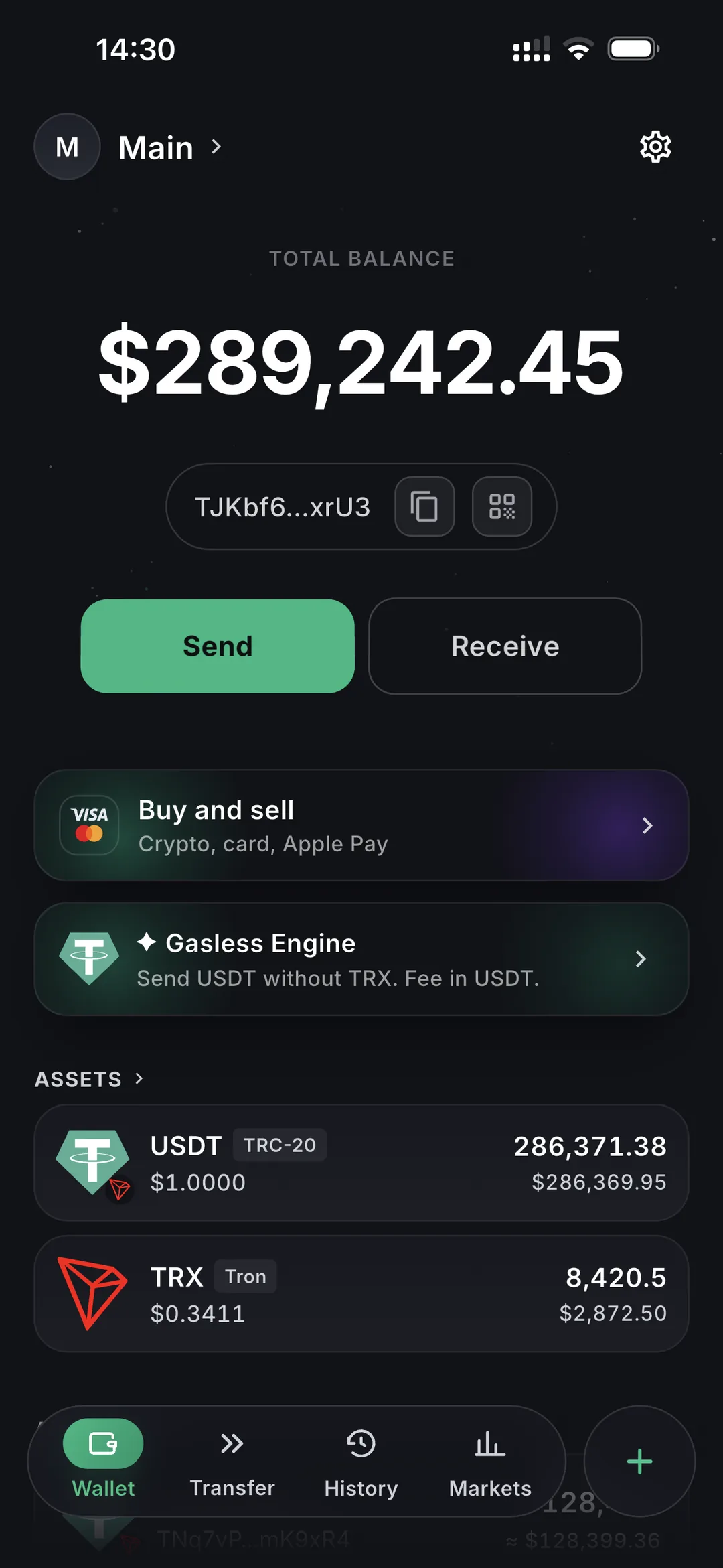
Sending USDT on TRON normally needs TRX for network energy and bandwidth. Oniq takes that on, so the fee is paid in USDT instead — up to 70% cheaper than covering it in TRX.
Your crypto stays yours.
ONIQ is a non-custodial wallet: your funds live on the blockchain rather than with a service, and the private keys stay only with you. No KYC, no registration, no handing control of your assets to anyone else — you manage your crypto yourself.
- Your funds are held by the service
- The service controls the private keys
- KYC and identity verification
- Accounts can be frozen or limited
- You own your funds outright
- Private keys stay only with you
- No KYC, no registration
- No account that can be frozen


How sending works.
- 01Enter address and amount
Paste, scan, or pick from your address book.
- 02Confirm locally
Passcode or Face ID signs the transfer on your device.
- 03Done.
Your transfer reaches the network and confirms within seconds.
Install it. Use it.
Create a wallet in a few taps — set a passcode, back up your phrase, and you're ready.


Private keys are created right on your phone
and never leave it.
Your seed phrase is generated on your device from the operating system's cryptographic random source, then sealed with a key derived from your passcode using Argon2id. The encrypted blob lives in the platform's secure storage — Keychain on iOS, EncryptedSharedPreferences on Android.
Derivation is standard BIP39 on the path m/44'/195'/0'/0/0, so the same recovery phrase opens the same wallet in TronLink, Trust, or a hardware wallet. You are never locked in.
Transactions are signed on your phone: the server builds an unsigned transaction and receives back only a signature. No code path sends a key anywhere — which you can verify by reading the code, because we published that part.
/// Full-range CSPRNG bytes (each byte 0-255). We pass this to bip39
/// instead of its built-in generator, which draws bytes with
/// `nextInt(255)` and therefore never emits 0xFF - a small but real
/// bias that shaves the entropy below 128 bits.
static Uint8List _secureEntropy(int n) {
final r = Random.secure();
final out = Uint8List(n);
for (var i = 0; i < n; i++) {
out[i] = r.nextInt(256);
}
return out;
}
/// Fresh 12-word BIP39 mnemonic (128 bits of entropy).
static String generateMnemonic() =>
bip39.generateMnemonic(strength: 128, randomBytes: _secureEntropy);The server never sees a private key. It builds the unsigned transaction; your phone signs it and returns the signature alone.
The passcode is stretched with Argon2id in a background isolate, so it can be slow enough to be worth something against a stolen device.
Key generation, derivation, signing and storage are public on GitHub. "Your keys never leave your phone" is a claim you can check rather than believe.
One wallet,
on every device.
Oniq is a non-custodial wallet for storing and sending USDT without holding TRX for gas. Download it free on iOS and Android — set up in about a minute.
Frequently asked questions.
A non-custodial crypto wallet built for everyday use. On TRON you can send USDT (TRC-20) without holding TRX for gas — the fee is paid in USDT instead.
You, and only you. Oniq is non-custodial: no accounts, no sign-up, and we can't freeze, send, or access your balance.
You can send USDT without holding TRX. The network fee is taken automatically in USDT — and it's up to 70% cheaper.
It depends on network load — usually around $2.5. The exact fee is always shown before you confirm the transaction.
Your Seed phrase and keys are encrypted on your device and kept in the phone's secure hardware. They're unlocked only by your passcode and never leave your phone.
The passcode can't be recovered. After 10 wrong attempts the app wipes itself, and you restore from your Seed phrase — so keep that phrase backed up.
Need a hand? We're here.
Real people, any hour. Message us on Telegram for the fastest reply, or send an email — you'll hear back from someone on the team, not a bot.